Seastex
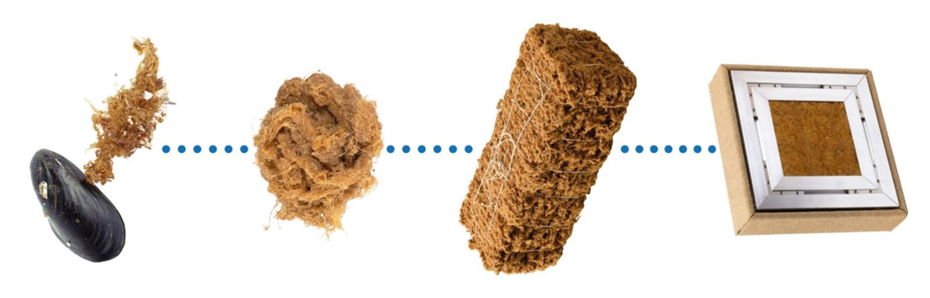
If you’ve ever visited Belgium and nipped out for food, there is one dish you will likely have seen on most menus: moules-frites (or mussels and chips for our English audience). Mussels are grown en masse, with an estimated 1.9 million tonnes produced globally in 2022. They can be grown on the seabed, on rafts, on wooden stakes, or on suspended ropes in the sea, where they are harvested at large scales. But did you know that the mussels on your plate look different from the ones growing in the sea? Mussels contain filaments known as mussel beards or byssus, which allow the mussels to stay rooted during stormy conditions. The byssus are fibres composed of proteins, which are secreted by the mussels and allow them to stick to surfaces. During processing, these byssus are removed and discarded, with a cleaned mussel being the primary focus.
Sander Nevejans, founder of Seastex, and a Belgian native, has been exposed to mussels since he was a child, using them as bait to catch crabs on family holidays. During the COVID pandemic, he saw a video about mussel harvesting and became curious about the byssus fibres produced by the mussels and what happens to them. He went down a rabbit hole, looking into their historical use and trying to understand if people could do anything with these fibres. His research went 2,000 years back in time, when large mussels known as the Nobel Penn Shell were grown, producing byssus up to 12 cm long. At that time, the fibres were used to make a textile known as sea silk, which could be processed into tunics. In the 1800s, various products, including gloves and scarves, were showcased at different events by French and Italian producers. The historical evidence suggested something could be done with the fibres, but his research showed that in the present day, the fibres were largely ending up in landfill.
Seastex was born from the idea that the fibres could be used rather than wasted, producing a sustainable product and helping to reduce the carbon footprint of the mussel industry. Sander contacted a mussel supplier, asked for fibres, and began to experiment and understand them in greater detail. With a background in interior design, Sander was drawn to this sector and quickly realised that the fibres showed excellent acoustic insulation, while also being naturally fire-retardant, making them an ideal material for interior design. Traditional acoustic materials are made of fossil-derived polymers and are therefore not sustainable.
Sander then spent the next two years optimising a process to clean the beards, which were contaminated with shells, algae, sediment and even microplastics. Once they had a cleaning process, they then needed to improve the actual fibre processing, where the fibre is converted into a finished product. Although there are many different types of equipment that can process fibres into textile products, these did not work effectively with their fibres. To improve the processing yield and ensure that the finished products were completely natural and free of fossil-derived ingredients, Sander embarked on an ambitious project: designing and making his own processing equipment, optimised for the mussel beards. These prototype machines were developed as part of an Innovate UK grant called Creative Catalyst, with Seastex able to demonstrate high conversion yields.
With successful cleaning and processing now demonstrated at pilot scale, Seastex is looking to grow and increase production of its acoustic materials. The company moved from London to Scotland to be closer to the mussel producers, taking the mussel beards from Scottish Shellfish, the largest mussel cooperative in Scotland, helping them minimise their waste. The company is currently at TRL7 and hopes to reach TRL9 as part of its next stage of development. They are working to undertake a life cycle assessment of their material, to get a sense of its overall climate impact, with internal studies suggesting it is climate negative.
Outside of interior and product design, the group is also exploring mussel byssus as a novel source of marine collagen for pharmaceutical, biomedical, and cosmetic uses. This collagen has the potential to support additional strategies to repurpose byssus by-products, creating added value and new commercial opportunities.
Seastex is interested in speaking with other mussel producers who wish to work with the company to help mitigate waste and improve their own sustainability credentials. Their first goal is to work with all Scottish mussel processors, taking their mussel beards, with Sander passionate about creating jobs in Scotland. They are also interested in speaking with experts who can streamline their certification process, with this key for sales of the acoustic panels and mass uptake. To investigate the collagen extraction of their byssus, they are seeking to engage with organisations interested in collaborating on R&D in biotechnology, chemical and biochemical engineering, and related fields. Seastex is supported by Glasgow City Council, the IBioIC, Innovate UK, Scottish Shellfish, The King’s Foundation and the Future Industries Demonstrator. If you are interested in speaking with Seastex, please reach out to Strategic Allies, and we will happily make an introduction.