Kāhu SiliconBio

Real-Time bioelectronic sensing technology for liquid chemical diagnostics
Continuous Hormone Monitoring: Listening to the Body’s Chemical Signals
The human body is constantly producing chemical signals that help regulate how it functions. These signals can also act as powerful markers of what is happening internally, sometimes before symptoms are obvious. Hormones are one important group of these markers: they act as messengers, telling different parts of the body when to start, stop, or adjust key processes.
Hormone diagnostics is a process where the levels of different hormones are measured from a sample of bodily fluid. Hormones present in the solution are identified, with specific hormones or concentrations able to diagnose specific conditions or provide useful insight. Real-time hormone tracking is particularly relevant to women’s health, where hormone levels are already used to understand and monitor fertility, ovulation, menopause, and other aspects of reproductive health. By tracking these changes, clinicians and individuals can better understand fertility cycles and identify irregular patterns that may point to wider health issues such as polyendocrine metabolic ovarian syndrome (PMOS – formerly known as polycystic ovary syndrome or PCOS) or improve success rates for in vitro fertilisation (IVF).
Hormone diagnostics is not new. A range of organisations already test blood, saliva, or other fluid samples for specific hormones, usually by sending the sample to a designated laboratory. These tests are powerful but only capture hormone levels at a single point in time. Because hormone activity changes continuously, a one-off sample offers only a limited view of what is happening in the body. The levels of female sex hormones such as oestrogen and progesterone fluctuate relatively reliably for most women over a monthly cycle. However, the cycle is different for every woman, and small fluctuations in either the level of hormone or the timing of the cycle can indicate significant medical issues.
At-home lateral flow-like testing does exist, but the accuracy can be low, or limited to very specific use cases – such as pregnancy tests. These testing kits still suffer from the limited snapshot they capture.
Kāhu SiliconBio is developing an approach designed to address this limitation by monitoring hormone activity continuously, through dermal patches, without needing to send samples to a laboratory. Its platform can detect multiple chemical markers, although the company is currently focused on hormone analysis for women’s health. The technology works by harnessing the sensitivity of living microorganisms, using them as the sensing element within a bioelectronic diagnostic system.
Bacterial Biosensors: A Faster Approach to Chemical Detection
Using biological organisms as sensing tools is not a new concept, microorganisms have evolved to be highly sensitive to a huge range of chemical targets. However, traditional biological sensors have limitations: they typically do not provide quantitative results and are relatively slow, often requiring hours to produce outputs, with protein-expression-based technologies commonly used.
Kāhu SiliconBio has developed a solution that overcomes existing problems by harnessing the inherent sensitivity of the way microorganisms physically move. Their approach uses a strain of bacteria that responds to chemical changes with measurable biophysical behaviour. When the bacteria encounter a specific chemical target, it triggers a response that alters their movement. This change in movement can be detected, indicating the presence of the target chemical, with results available in seconds.
The foundational research for this technology originated at the University of Edinburgh, where the team would use microscopes to observe these movement changes, demonstrating a fast and highly sensitive method for chemical detection. The phenomenon has been studied since the 1970s, requiring optical microscopes to observe the changes.
Merging Bacteria with Semiconductor Technology
Observing bacterial responses through a microscope is not practical for real-world applications. To address this, Kāhu SiliconBio has integrated their sensitive bacteria with electronic components that detect changes in bacterial behaviour as measurable signals. This provides instant, quantifiable outputs, allowing rapid analysis of chemical targets within the liquid solution.
A collaboration with the University of California, Berkeley enabled this seemingly “sci-fi” combination of biology and semiconductors, resulting in the first functional prototype, which has since undergone further optimisation and has recently been published.
Following this milestone, Kāhu SiliconBio was founded in 2025. Their CEO, James Flewellen, has been involved in the project since 2021 and has worked on technical and commercial aspects. They have filed a patent covering the chip format, which embeds the bacteria directly within the device. The current prototype contains a sensing chip which is a few square millimetres in size, with liquid samples introduced directly into the system for rapid testing.
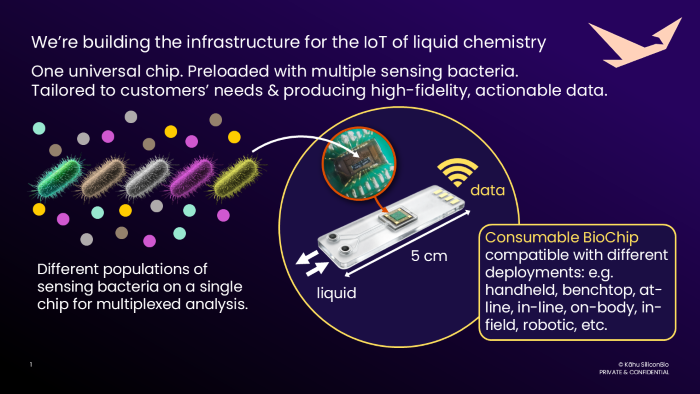
How can these bacteria detect a wide range of chemicals? Kāhu SiliconBio are not only experts in sensing, they are also skilled in engineering their microorganisms. They create new bacterial strains specifically to detect new chemical targets using advanced bioengineering techniques, effectively building a diverse suite of sensors.
The team is developing a library of bacterial strains capable of detecting numerous chemical targets. Each strain is compatible with the same silicon chip format, ensuring that the detection output remains consistent across different chemical tests.
Continuous Hormone Monitoring for women’s health
Kāhu SiliconBio was recently awarded £1.25 M in funding from SPRIND to develop its technology for hormone monitoring in women’s health. The company plans to engineer one of its bacterial strains to be sensitive to five specific hormones associated with conditions such as PCOS (now PMOS), as the basis for a wearable sensing platform.
The sensor is intended to continuously monitor hormone levels in biological fluids through dermal patches, providing real-time insights that could support personalised action depending on the hormone being tracked. As part of this project, the team is interested in speaking with organisations working in women’s health, hormone diagnostics, wearable sensing, and related areas that may wish to collaborate.
Beyond hormone diagnostics: Fermentation, Aquaculture and Farming Applications
Kāhu’s underlying technology can be used to detect chemicals beyond hormones, working in any water-based environment. The team is interested in speaking with potential partners who have a chemical or an application where it could be applied. The following scenarios have been identified as potentially interesting for future development work:
Fermentation and bioprocess monitoring
Why? Real-time monitoring of fermentation and bioprocessing is challenging, making it difficult to know whether the process is complete, stuck in an unwanted state, or if conditions need adjustment.
What? The sensors detect key chemicals, such as fermentation metabolites and process end-products, to provide real-time feedback on fermentation progress, enabling more precise control.
Aquaculture
Why? Fish raised for commercial purposes are highly sensitive to environmental changes, which can lead to mortality if conditions fluctuate.
What? The sensors enable continuous monitoring of water quality, detecting metal ions, nutrient molecules, and pollutants to protect aquatic life.
Farming
Why? Monitoring effluent runoff from farms is critical to prevent damage to rivers and the surrounding environment. At the same time, having clean water is a key input for crop irrigation and hydroponics.
What? The team is developing sensors that detect nitrates and phosphates present in water and can also monitor environmental hormones and endocrine disruptors, providing actionable environmental data.
What’s next with Kahu SiliconBio?
Using the recent funding, Kāhu will investigate the potential of their sensors for women’s health. They are also seeking additional potential customers within their other target sectors to further validate and optimise the technology. In addition, Kāhu SiliconBio is open to collaborating with clients interested in bespoke sensing solutions. By engineering and tuning their bacterial strains, they can develop customised sensors tailored to specific chemical detection needs. They are also planning on opening a fundraising round in early 2027 and are interested in speaking with interested parties.
They have received additional grant funding from UKRI’s ICURe Pre-accelerator programme for market discovery and the EPSRC to develop their technology, and have received funding from Scottish Enterprise to commercialise it through the High Growth Spinout Programme. They recently completed the ChipStart UK programme managed by Silicon Catalyst UK as part of the third cohort. Since founding the company, the team has secured over £1.5 M in non-dilutive funding.
We are looking forward to seeing Kāhu SiliconBio’s journey, turning this science-fiction solution into reality. If you are interested in speaking with Kāhu SiliconBio, please reach out to Strategic Allies and we would be happy to make an introduction.
Image courtesy of Kāhu SiliconBio