Concretene
Graphene-based liquid admixture that improves the microstructure of concrete
When thinking about the climate crisis we are currently facing, our thoughts regarding CO2 emissions might turn to car pollution, fuel consumption to heat our homes, and incineration of plastics. However, these contributions to the 37.8 Gt of CO2 produced in 2024 are eclipsed by the volumes of gases produced by industrial operations. One such sector is the construction industry, where 7-10% of global CO2 is emitted annually in the production of 4 billion tonnes of cement. As the world’s population continues to grow, cement is required for the building of new homes, offices, roads, and other infrastructure. Finding solutions to reduce carbon embodiment in the manufacture of concrete will be vital in the coming years if we hope to curb global emissions, and that’s where Concretene comes in. They have developed a graphene-based solution to reduce the cement required in concrete manufacture by 20-30% depending on the application, and in doing so, the embodied carbon by close to the same percentage.
Concretene’s origins date back to 2019 when founder Alex McDermott attended a talk on the use of graphene in industrial applications, including concrete. As a civil engineer working in the construction industry, Alex saw the potential for this versatile material to reduce CO2 emissions in the manufacturing process. Craig Dawson (now Chief Scientific Officer at Concretene) helped develop the technology that allowed graphene to be incorporated into the concrete while working at the University of Manchester. From there, the company received an initial Innovate UK grant to scale up their technology for real-world applications.
Concretene truly began as a company in 2023, spinning out from the University of Manchester, and today has more than 20 employees, comprising scientists, technicians, and operations staff. This includes six post-doctoral researchers, working in teams to investigate types of graphene, how they can be optimally formulated into Concretene’s patent-pending admixture, and how the solution is best deployed into concrete. As well as having laboratory and office space in the Graphene Engineering Innovation Centre in central Manchester, the company has a materials testing facility with full digital automation in the adjacent Sister innovation district.
Concretene’s admixture is a graphene-based solution that is added during the manufacture of concrete, improving its microstructure. Graphene nanoplatelets and graphene oxide are combined with other proprietary chemicals, enabling the normally hydrophobic graphene to disperse in concrete, a water-based system. The refined structure of the finished product allows for a reduction in cement required in the manufacturing process, while maintaining or even improving the concrete’s performance. Furthermore, the admixture speeds up the curing time of concrete, which in turn improves overall productivity, and it plugs directly into standard batching plant procedures for chemical admixtures, with no disruption to operations, reducing barriers to adoption.
At scale, the product will be cost-neutral, which, in the words of Alan Beck, Head of Product, “will help decouple the idea that green technology is more expensive”. Not only does the solution reduce CO2 emissions by requiring less cement, the graphene itself is produced from carbon capture, further contributing to a circular economy. Concretene has worked with UK green-tech company Levidian, whose patented LOOP system splits methane (CH4) into hydrogen and high-quality graphene nanoplatelets. This means waste streams from water treatment, farm slurry, landfill, etc, can be valorised and produce a repeatable, effective raw material for Concretene production.
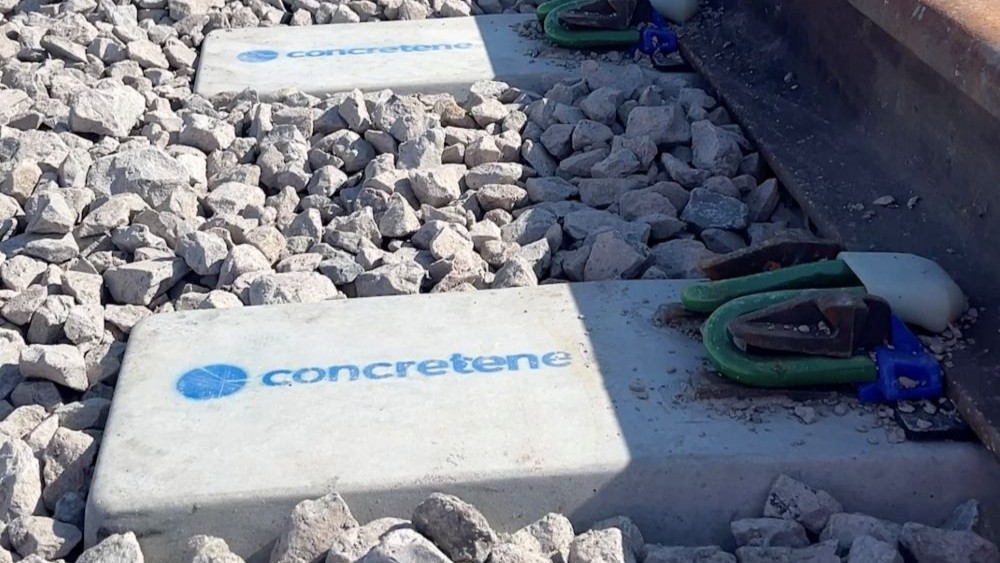
Concretene has already had to overcome challenges on the road to scaling up. They previously incorporated the product into concrete used to lay a roller rink in Manchester in 2021, as well as gym floor and parking bays. However, their supply of graphene from a third-party was unreliable, and so they applied for and won £2m of UK government funding to investigate the graphene supply chain and optimise a second-generation product. The company now has a more reliable, environmentally-friendly graphene source, and the admixture is currently being used in trials for railway sleepers, foundation piles, and floor slabs. Early next year, they plan to complete their pilot plant, bringing with it a tenfold increase in admixture production capacity from 50 litres per day to 500. Furthermore, they expect to have accreditation for their material by Q3 2026 and are in discussions with United Utilities and CRH Group to collaborate in order to bring the technology to market.
Indicative of the confidence that Concretene’s product will be a success, the company has raised over £6.5M in venture capital funding to make their solution a reality. This includes financial backing from LocalGlobe in 2022 for their Seed fund, Molten Ventures in 2024 for Seed+ funding, and ARUP (which has a sweat-equity stake in Concretene, working on the accreditation pathway).
Concretene is looking to raise Series A funding, and further information can be found here. Strategic Allies Ltd (SAL) wishes Concretene all the best for their continued growth in the coming years. Once the solution becomes widely commercially available, there will be little reason not to use their eco-friendly solution to improve concrete durability and curing!
Image courtesy of Concretene