200,000 Deaths a Year: How Digital and AI Technologies Are Tackling The Medication Adherence Crisis

Medication adherence refers to the extent a patient’s behaviour corresponds with taking their medications optimally as prescribed. Poor medication adherence is a common phenomenon and a major global health crisis, leading to adverse patient outcomes such as increased disease progression and morbidity, higher hospitalisation rates and reduced quality of life. Studies showed that only about 50% of patients take their medications as prescribed. Poor adherence has been associated with 200,000 premature deaths and €125 billion of wasted costs in Europe. Similar data is seen in the USA with medication non-adherence estimated to cause approximately 125,000 deaths, 1 in 10 hospitalisations and costing the healthcare system as much as $300 billion a year. Digital and AI technologies are increasingly being explored as a solution to enhance medication adherence while fostering communication between patients and healthcare professionals. A few examples on the different technologies are covered in the next section.
Smart closures
These refer to electronic caps that are used for monitoring the patients’ adherence of medication by tracking the opening of the caps. These caps are usually designed to fit standard pharmacy prescription pill bottles.
- Gx Cap by Gerresheimer, in partnership with RxCap, is an example of a smart cap, powered by Long Term Evolution (LTE) technology. The cap monitors vial openings and sends text reminders if the vial remains unopened for a certain period of time. Patients who enrolled in the monitoring programme are provided with the Gx Cap by their pharmacist, enabling pharmacists to track the patient’s medication adherence and intervene as necessary thus fostering stronger pharmacist-patient relationships. Available across USA and Canada, the cap comes with a pre-charged battery that can last for up to 12 months.
- PatchRx is another similar example of a smart pill bottle cap that is being used in clinics and pharmacies across the USA for remote monitoring and improving patient adherence. The smart cap, named the PatchCap, is a peel-and-stick device about the size of a 10p coin that can be attached to the underside of any regular prescription pill bottle cap. It detects opening events to track medication adherence. The cap is paired with a plug-in gateway device where collected data is aggregated and transmitted to the cloud. PatchRx claimed that 54% of patients showed improvements in consistency of medication routine over 6 months and a 16.6% increase in patients with more than 80% adherence taking.
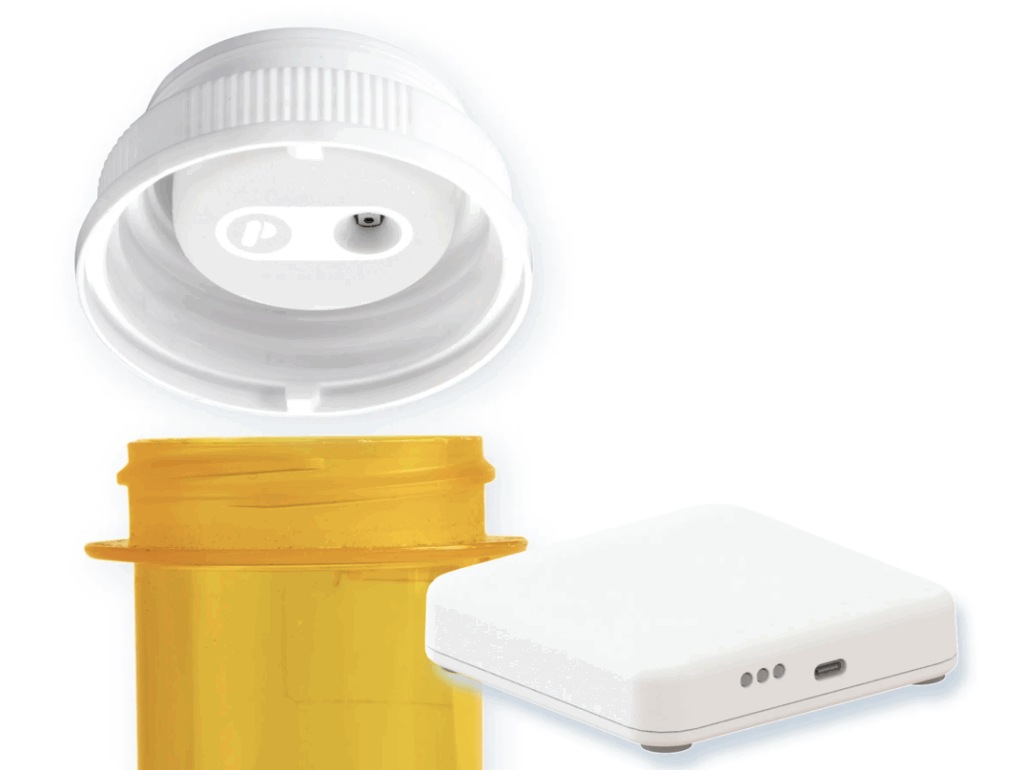 PatchRx smart pill bottle cap
Smart pill bottles
These are pill bottles containing electronic sensors designed to track a patient’s medication intake while providing physicians / pharmacists with real-time data to monitor adherence and intervene with patient support when needed. Some examples include:
- Aidia Smart Bottle by AdhereTech is a container incorporating sensors with capability to automatically measure how many pills are in the bottle and when the pills were taken. It sends reminders to patient when a dose is missed via automated phone call or text message as well as on-bottle lights and audible chimes. The alert stops once the pill bottle is opened and the device resets its alarm for the next dose. It is given by healthcare providers to patients in the USA, thus requiring zero patient set-up and can be operated anywhere where a mobile phone would work without needing Bluetooth or Wi-Fi. If a patient regularly misses a dose, it will send a notification to alert the healthcare provider who will then contact the patient to understand the reasons for non-adherence.
- PillSafe® is a wireless pill distribution control system designed by doctors to secure the delivery of prescription medications from pharmacy to home, preventing uncontrolled access to drugs. A pharmacist fills PillSafe® container with medication, snaps lid in place and programmes the bottle to dispense only the required dosage on the specific schedule set by a doctor. A patient will need to enter a 3-digit access code to access medication and once the required dose has been taken, the device locks again and the countdown timer restarts for the next dose. The container also comes with an electronic net that can detect any tampering and can be programmed to either destroy the medication or notify the pharmacy / physician of the breach. PillSafe® is reported to feature an AI Agential Avatar, transforming a passive pill bottle into an interactive healthcare system that provides real-time coaching, dosing support, and engagement. The company recently secured its primary investment in seed round and aim for a commercial launch in 2026.
Digital medication dispensers
Digital dispensers are designed to automatically dispense pills at scheduled intervals while providing patients with reminders to take the prescribed medication on schedule. Many of these have capability to dispense multiple pills, unlike smart pill bottles that focus on singular medication. There are several automatic pill dispensers available in the market e.g. Karie and Hero.
- Karie, developed by a Canadian healthcare technology company, AceAge, is a connected home health appliance capable of organising, scheduling and dispensing multiple pills. A pharmacist loads multi-pouch medication strips into the dispenser cartridge, the patient then slides in the pre-filled cartridge into the Karie device at home and it automatically dispenses pills according to the set schedule. When it is time for a dose, the device activates a flashing light and audible chime. With a push of a button, the correct medication dose is delivered to the patient. Karie will notify care givers or family members if a dose is taken too early, too late or missed. Karie also comes with optional PIN entry and facial recognition to prevent medication errors and accidental dispensing.
- Hero is a countertop, coffee-maker sized, app-enabled pill dispenser that alerts a patient when it is time for their dose and delivers the required medication into a clear cup with a press of a button. The Hero app is used to set medication schedule and dose. The device can be connected to Wi-Fi and is capable of holding as much as a 90-day supply of 10 different types of pills. Similar to Karie, Hero chimes and blinks when it is time for a dose and if the patient does not take the pills within 15 minutes, notifications will be sent to family members or carers. There is an option to set a 4 digit passcode to restrict access to the medications stored inside the device and the same code can also be used for dispensing pills. Hero works on subscription model of $45/month or $30/month if paid in advance with a minimum of 12-month commitment.
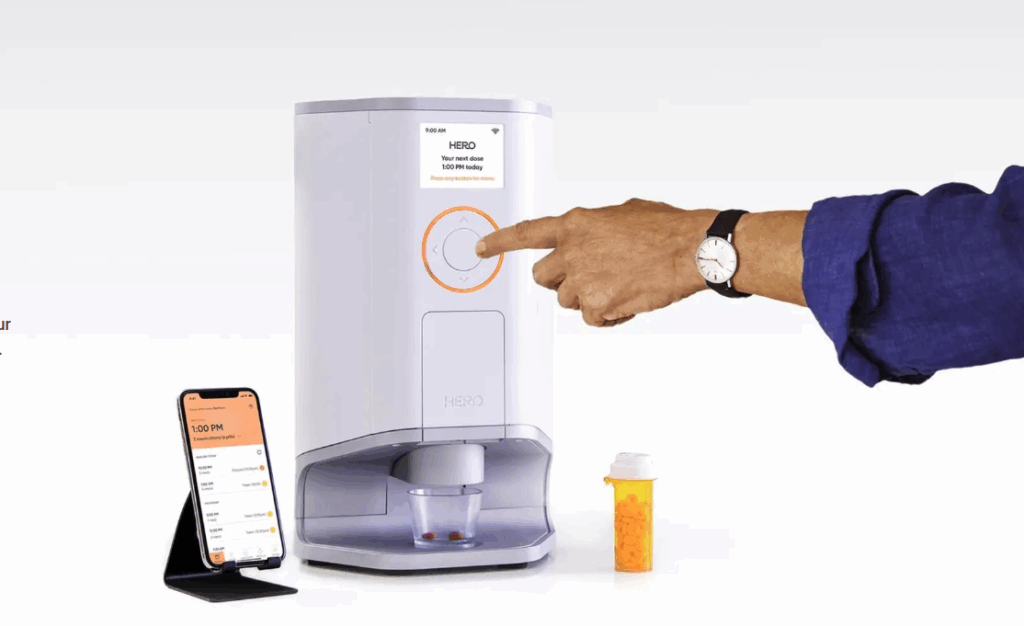 Hero smart pill dispenser
Smart inhalers
Digital inhalers are increasingly being adopted to improve a patients’ adherence to asthma therapies and prevent asthma flare-ups. Asthma affects over 300 million people worldwide and most asthma-related exacerbations can be avoided with proper treatment. These inhalers integrate connectivity with a mobile app and come with electronic sensors to track, monitor and analyse inhaler technique. Respiro by Amiko and Hailie® Smartinhaler® by Adherium Limited are two examples of commercially available devices.
- Respiro’s sensors can be designed as an external device to be attached to existing inhalers such as the NEXThaler® (Chiesi Farmaceutici) or Ellipta® (GlaxoSmithKline) or built into an inhaler e.g. Berry Global’s RS01X digital inhaler. The AI-enabled sensor, powered by ARM microprocessors, collects inhaler use data and uses machine learning to interpret vibration data from the inhaler for calculating inhalation lung capacity, flow rates, and technique. These data are sent to a mobile app wirelessly and shared with healthcare providers, enabling more effective management of the patient’s condition. Device was reported to improve adherence by 52% and inhalation technique by 48%.
- Hailie® sensor is designed to be attached to existing inhalers without interfering with normal inhaler use. Similar to Respiro, Hailie® monitors inhaler use and technique and provide real-time feedback to patient via the Hailie app while data is sent online to a physician through the Hailie portal. Hailie® was reported to demonstrate a 59% increase in adherence in adults and an 80% reduction in hospital admissions in children. In 2024, US FDA cleared the Hailie® Smartinhaler® for use with AstraZeneca’s Airsupra® and Breztri® inhalation devices. Also in 2024, Hailie® was adopted in the UK’s first NHS study of digital ‘smart inhalers’ for children with asthma.
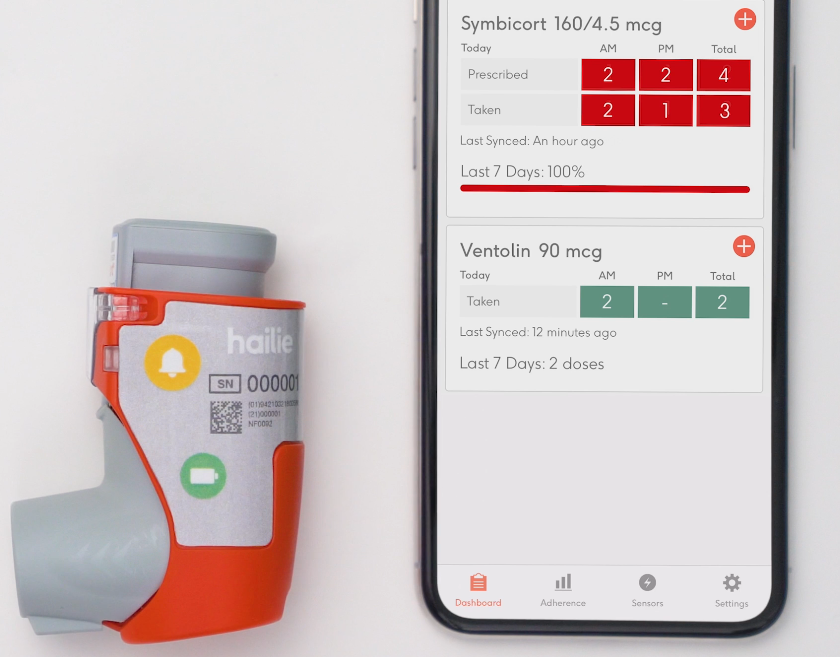 Hailie sensor
Digital pills
Many of the automatic pill dispenser solutions that have been discussed earlier can only track whether a patient has opened the pill bottle or if pills have been dispensed at set schedules but these technologies cannot confirm if the patient has consumed the necessary pills. Here comes the digital pills where pills are designed with ingestible electronic sensors to provide precise and real-time confirmation of medication intake.
- In 2021, the US FDA cleared etectRx’s ID-Cap™ System, a hard gelatin capsule embedded with ingestible wireless sensor. After the capsule is swallowed, the sensor transmits a radio frequency (RF) signal from within the stomach to an external reader. This reader, available in the form of a wearable necklace or wristband, collects and transmits ingestion data into a cloud-based server which can be viewed by the patient via an app or displayed to clinician on a dashboard. The sensor is then eliminated safely and naturally via a patient’s gastrointestinal tract.
- Researchers at MIT have also recently, in January 2026, introduced a smart pill capsule containing a biodegradable RF antenna which sends out a signal when the pill has been consumed. The outer layer of capsule is made of gelatin coated with a layer of cellulose and either molybdenum or tungsten, blocking any RF signal from being emitted during storage or handling. Once swallowed, the coating dissolves, releasing the drug with the RF antenna. The RF antenna picks up RF signal from an external receiver, confirming medication consumption within 10 minutes of the capsule being swallowed. Most components of the capsule break down in the stomach within a week after sending out the RF signal while the RF chip passes out of the body through the digestive tract. The RF antenna is made using bioresorbable materials i.e. zinc embedded in cellulose particle to minimise the potential risk of any blockage of the gastrointestinal tract. The researchers are planning further preclinical studies and hope to test the system in humans soon.
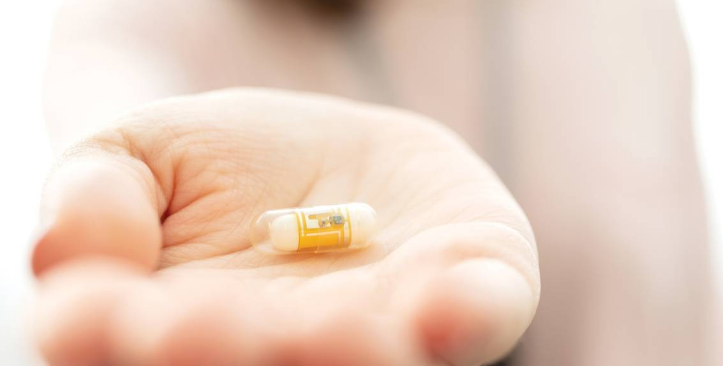 EtectRx’s ID-Cap™ System
The above covers a very small selection of products that have incorporated digital and AI technologies as a mean to improve a patient’s medication adherence behaviour. With digital therapeutic technologies emerging as a promising tool to transform medication adherence, it is believed that the uptake of such technologies will accelerate thus making digital medication adherence technologies more widely available. Strategic Allies Ltd (SAL) have worked with multinational clients across various industries who are interested in identifying new and innovative digital technologies. If you’d like to find out more about how we can help you to explore how digital can be integrated into your product to differentiate your offerings and/or exploit new markets, please contact John Allies at john@strategicallies.co.uk